
Please include a picture of you that you feel captures your essence (ideally this isn’t a traditional headshot, but follow your heart)!
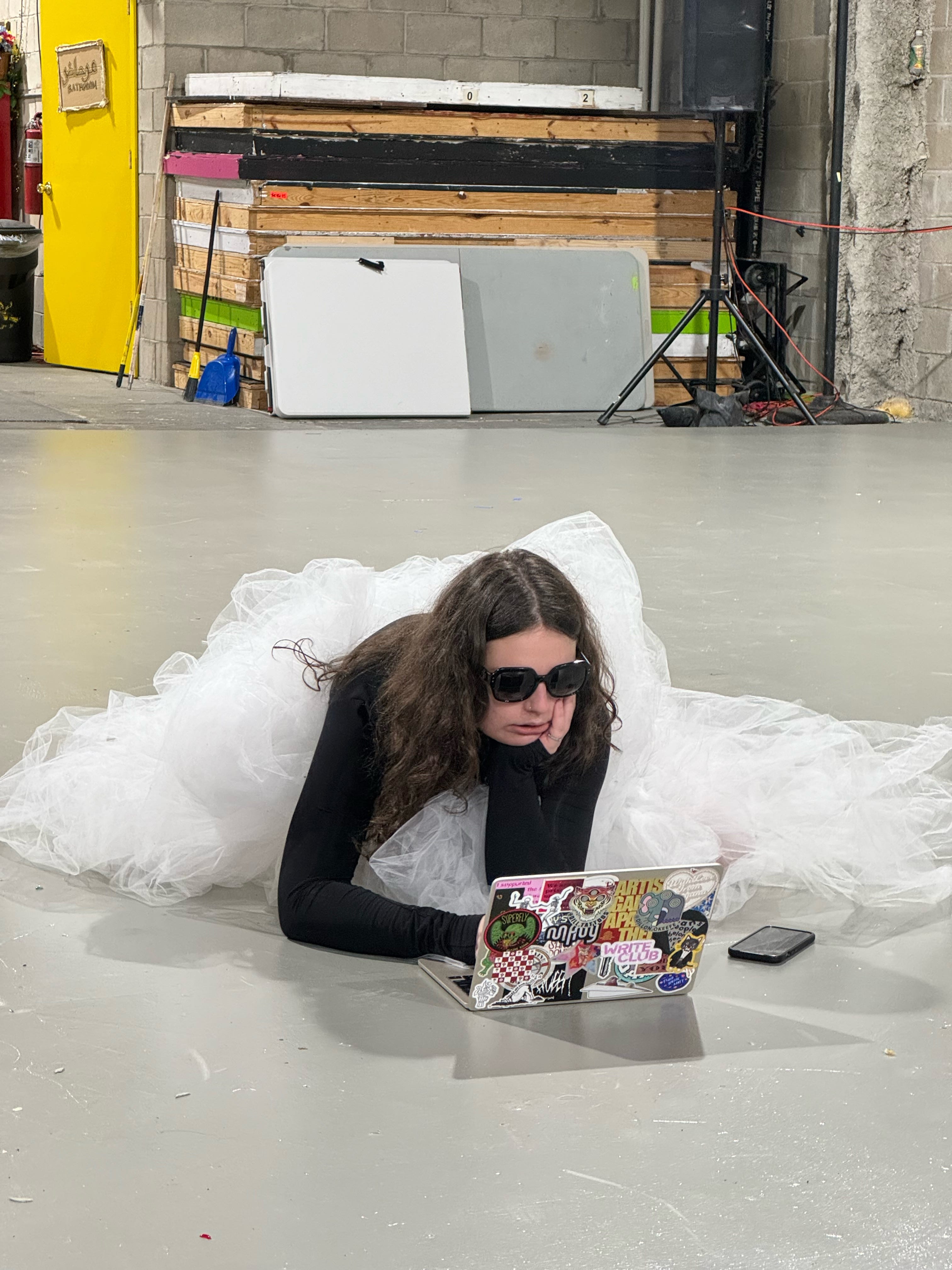
What do you consider to be your hometown?
Montreal, Quebec, Canada.
Where are you currently based?
Brooklyn, New York.
What idea or project are you fixated on right now?
The project that I am mothering most intensely right now is Baby Butcher Choke For Free, running March 18-21 at The Brick. It’s a laialeah project, meaning that it’s co-created and performed by my collaborator Eulàlia Comas and myself. We make what we call noise theatre, which involves:
Pure formalism by way of rigorous composition
Iterative process, where pieces of past projects are collaged into new ones
Intense audience-spectacle relations, particularly emerging from the sensory realm
Containers that we as performers can’t get a complete technical or logistical grip on
Experiments in ambient performance
A DIY ethos and resulting aesthetic
Post-dramatic karaoke
Laia and I met as interns at The Brick in early 2023, and it’s a theatre that continues to be one of the centres of gravity of our lives — professionally, artistically, interpersonally. We’ve been giddy about building something that could only be performed there; we’re prodigal daughters in the ancestral candy shop. We made our last show, MOBILE WASH FEMALE LOCKER ROOM, for my apartment. In scale, capacity, and reach, Baby Butcher Choke For Free is an escalation of our practice in site-specificity, but we still get to maintain the privilege of building in a space we have strong emotional ties to. Also, for the first time, we’re directly involving people other than ourselves in a laialeah project: our friends Jonathan Schatzberg, Isa Nicdao, Robin Margolis, and Jason Driver are working on the show with us.
I am really, truly over the moon about Baby Butcher Choke For Free. The gears are spinning hard. Laia and I have collected about a dozen musical instruments and are constantly sending each other voice notes of potential arrangements. I’m deep in the process of designing a video drone for our 1987 Sony CRT monitors, obsessively capturing video footage wherever I am. If anyone reading this in New York City owns cow paraphernalia, please email me.
What are your other current obsessions (that aren’t necessarily related to your work)?
Season two of The Pitt
Alienating syntax
Small dogs in snowsuits
Eating food onstage
Archiving performance
Stacy Grossfield’s metamorphosis iii
My friend Ái Vy Luu’s Suzuki Omnichord, which I’m borrowing for Baby Butcher
The Instagram accounts breedingcastle, ig.oo_o, and crisis.acting (currently suspended, tragically)
Please share a formative influence that shaped you as an artist.
My parents taking me to the opera when I was a toddler. I acquired a taste for big noises, big feelings, and maximalism very early on.
What themes, images, or other echoes do you find recur in your work?
Anatomy suffering from injury or disease
Girls being bored in the house
Mothers
Big t-shirt pyjama top
The song In Spite of Ourselves, by John Prine, as covered by the Viagra Boys
Unpleasant sex
Bodily fluids
DIY medical procedures
Teeth
Names starting with the letter M
Physical violence between loved ones
Repressed desire
The song Jupiter 4, by Sharon Van Etten
Large sheets of plastic
Wires and cabling goddamn everywhere
Orgasms
Birds
Please indulge me in talking a little bit about your process, whatever that means to you. (Feel free to be as brief or as expansive as you like.)
I’m a wearer of many hats, so my process looks like many things. The hat of playwright is the one I’ve worn the most consistently.
My process as playwright is my most solitary one. When I have the time to luxuriate in creation, I happily spend long periods of time “not” writing, or rather, engaging in the less obvious parts of writing. I listen to the same song ad nauseam, read books that may resonate with the project in any capacity, take long walks between commitments and rotate the play around inside my head, collect images of artwork that feel like they’re of the same aesthetic, thematic, compositional, or textural world, see shows and discover what I want to riff on, drop many, many semi-coherent thoughts into my notes app, write about the project by hand. I let the thing marinate, let the iron get hot.
I am most activated as playwright in the week leading up to a draft deadline. This looks like weekends spent locked up in my apartment, manic pacing, caffeine, long nights, boxes of crackers munched on absentmindedly, erratic migration patterns between my couch, desk, and bed, my cats curled up on my lap as I write. I’m a big fan of a three-day marathon to execute a page-one rewrite. There’s a very intense clarity that comes with that tight squeeze. I’ve always been someone who thrives under pressure, and I find myself most efficient and engaged when there’s an undercurrent of semi-controlled panic in my playwriting, when I have to hand myself over completely to the thing or it won’t get done. If I’m working on a projected that I’m genuinely invested in, my thoughts are always coloured by it, but during these trysts— because that’s what they are, really— my whole person is saturated. Urgency in process also awakens the more mathematical side of my thinking, where playwriting turns into solving for x; finding a cutting insult within the boundaries of the lexicon I’ve defined, finding the right sequence of action for a gesture I won’t compromise on, finding what behaviours would alienate characters from each other the most. In the more feverish bursts of my process, emotional impulses are funnelled through a mechanical approach, and I strike the balance that I find crucial to successful theatremaking. Leslie Ayvazian, who was Head of Playwriting while Sophie and I were at Columbia, often talks about gut intelligence. I think about that a lot. Playwriting is both sensual and methodical.
I see so much theatre that I find completely stuck inside of its own head. (We’re talking about plays here, but this is also true for other modes of performance.) Playwrights are eager to show that they know how to mimic conversation, that they can build a coherent Aristotelian plot, that they can cobble together recognizable archetypes with some choice idiosyncrasies. That’s not impressive. Anyone can learn how to do that. I’m looking for theatre that is committed to making me feel in ways that are surprising to me, that works its way under my skin and into my entrails. I want to laugh until I cry, freeze in horror, get turned on. I want to know that something larger than me has me in its grip. Live performance is an inherently charged, volatile thing. There is no real barrier between the performers’ bodies and the audience’s. Our nervous systems don’t know that what we’re watching is fake. As a playwright, you are crafting the groundwork for an audience’s psychosomatic journey. This is an immensely powerful thing. There’s a lot of intellectual busywork involved in playwriting, but it’s worth nothing if you’re not invested in building your audience’s visceral responses the most thorough of springboards. This takes a lot of skill, a lot of patience, a lot of curiosity about other people, faith in your gut, faith in your collaborators, and a willingness to be wrong. I find that many playwrights are completely disconnected from the raw power of what it is they’re doing, and end up creating work that is shallow, masturbatory, and unsurprising, completely uninterested in an audience’s experience of the work. It’s a waste of live theatre. It’s bad playwriting.
Quite frankly, most theatregoing audiences are emotionally neglected. The difference between an audience that is being engaged (not an audience that is engaged— an audience that is being engaged) and one that isn’t is fully palpable. Listen to the quality of the laughter, if it’s polite, if it’s I-get-the-joke-ha-ha laughter. Pay attention to the thickness of silence, or if there’s a whole lot of shuffling. When an audience is completely invested, they unknowingly claim greater freedom to audibly react. They can’t help it.
Returning to process: people are often concerned with how to create sustainable artistic practices, how to engage in process without burning yourself out. I think that’s important, but I think that artistic process is an unwieldy beast that resists full control. We can build our rituals, sure, but we can’t know where the work will take us, how obsessed we’ll become, just how much electricity will be coursing through us. I push myself in process not only because I want to, but because it’s the most satisfying way to feed the adrenaline-seeking parts of my brain, which I don’t seek to dull, but learn to manage. (This is especially true in my performance work, where I often put myself through it onstage.) When starting a process, you also can’t know what muck from the clogged parts of yourself you’re going to dredge up. I think that going out of your way to avoid touching what hurts not only creates work that is emotionally blunted, but that will read as false. Sometimes, resistance to what your own work evokes in you may be a sign that it’s not quite time for that project, and that’s fine. Whether we like it or not, the creation of art holds up a megaphone to what inside of us wants to be articulated.
I believe in obsession in creation. I believe that discussing artistic process in terms of “healthiness” reduces it to a black and white binary that its very nature defies. I believe in not treating being an artist as a 9-to-5 that I clock out of at the end of the day. I believe in processes that take a little chunk out of me. I believe in believing that I do have something special to say, actually, because nobody else is going to believe it if I don’t. I BELIEVE IN MY TALENT! I believe in surrounding myself with people who get it, in taking a joke, in recovering after a sprint, and in knowing that it’s okay, I’ll live. I also believe that my approach will possibly mellow out as I get older, but I’m less than a month shy of twenty-five, so this all checks out. I welcome whatever changes in my philosophy occur. Life is long.
I know that you run a performance space, box machine. Has taking on this administrative/curatorial role informed your artistic practice at all?
I’ve been running box machine with Laia out of my apartment since June 2025. Curating and producing has immensely affected my artistic practice, as in, I’ve realized that curating and producing are core elements of my artistic practice. I wear these labels proudly. There was something incredibly liberating in realizing that I want to spend as much time championing other people’s art as I do my own. It’s given my own artistic work the space to breathe, which is nice. There’s always something for me to do, even when I don’t have it in me to be the creative force behind a project. Regardless, it is so, so immensely satisfying to see someone who you believe in reach a new audience and succeed, and it’s extra special when you’ve facilitated it. I knew that curating-producing was it for me when I realized that I was experiencing the same high after box machine shows as I do after my own work.
box machine has made me think a lot about how, as young artists coming up in the same environment—let’s say, everything adjacent to the Brooklyn experimental theatre world—our work is all so entangled. We have similar influences, we’re exposed to the same cultural movements, we see the same shows, and we all respond differently, but everything we make partially emerges from the same shared source. I’ve started to find a lot of comfort in that. It’s good to feel like a small part of a bigger thing. In a similar vein, the work happening at box machine has been a wellspring of inspiration for me. I love to include nods to my friends’ work in mine, and box machine has set off this beautiful, regenerating cycle of amicable stealing; artists will interpolate gestures from previous box machine performances within theirs, and then Laia and I will come up with our own version of that, like a trail of box machine Russian doll easter eggs. It’s very cool.
Also, box machine has proven to me what I always knew was true: you don’t have to make a big deal out of throwing a party after a show. A good show is a party.
What do you look for in your collaborators?
Honestly, I like working with my friends. At this point in my career, for my own projects, I’m mostly doing that. Not all friends make good collaborators, and not all collaborators make good friends. Over time, you develop a gut instinct over who belongs in what category. It’s really important to listen to it. Other than working with people I’m already friends with, I like becoming collaborators with people who I’ve met through their work. As a playwright, I experience this especially with actors; I’ll see them in something and go, this is who I need for a Leah Plante-Wiener play. This is a fit. I’m often drawn to actors who have mastered a dry affect, who aren’t afraid to get really, really strange and alienate their audiences, who have a strong grip on unconventional text and an ear for rhythm, and who are committed physical performers. As a curator-producer, I’ll see someone’s work, and if I’m really excited by it— and it’s a specific excitement that comes from my unique tastes, obsessions, itches, etc.—I’ll immediately start thinking about how, when, and where I can produce them, whether that’s at box machine or part of a larger lineup somewhere else.
I look for collaborators who are warm, personable, and generous in their excitement about the work. A strong sense of humour is crucial to me. I like artists who think hard and show their math. I want to work with people who get as obsessive with their process as I do, but with whom you can also have a normal, lighthearted conversation. The balance is really important. I also want to work with people who have distinct voices, whose work feels like it could have only been made by them. Similarly, I’m drawn to artists whose work mirrors what I’m investigating in mine, but who offer something that I couldn’t have figured out myself. I look for collaborators who are big risk-takers, who aren’t afraid of explosive gestures, wading through taboo, and intense audience experiences. I want to work with people who are comfortable with not having immediate answers, and who’ll just try a thing for the sake of trying. I also look for collaborators who are curious about what’s happening in the culture, and who pay attention to what’s happening around us in the performance and theatre worlds. Everything you make is in conversation with everything that’s being made, that’s been made, and that will be made. It’s important to me to have collaborators who go out of their way to not create from inside a vacuum.
What changes would you like to see in the industry?
Government funding, LOL.
Plugs, please!
Our first box machine show of the year is on February 8th! The artist is Eka Savajol, whose work resonates with me in a frightening capacity. You can sign up here. Spots are limited, but the performance will be happening twice that day, which is an exciting new model for us.
I am associate producer on Gooey’s Toxic Aquatic Adventure, running at the Bushwick Starr from February 4th to the 21st. It’s crafty, maximalist, big-hearted, puppet-centric fun. I am incredibly fond of this project.
I recently became Director of Promotion and Documentation for the CATCH Performance Series, a long-running downtown series of multidisciplinary performance events. We haven’t announced our first show of 2026 yet, but keep an eye out in the spring.
My Instagram :)