
Please include a picture of you that you feel captures your essence (ideally this isn’t a traditional headshot, but follow your heart)!
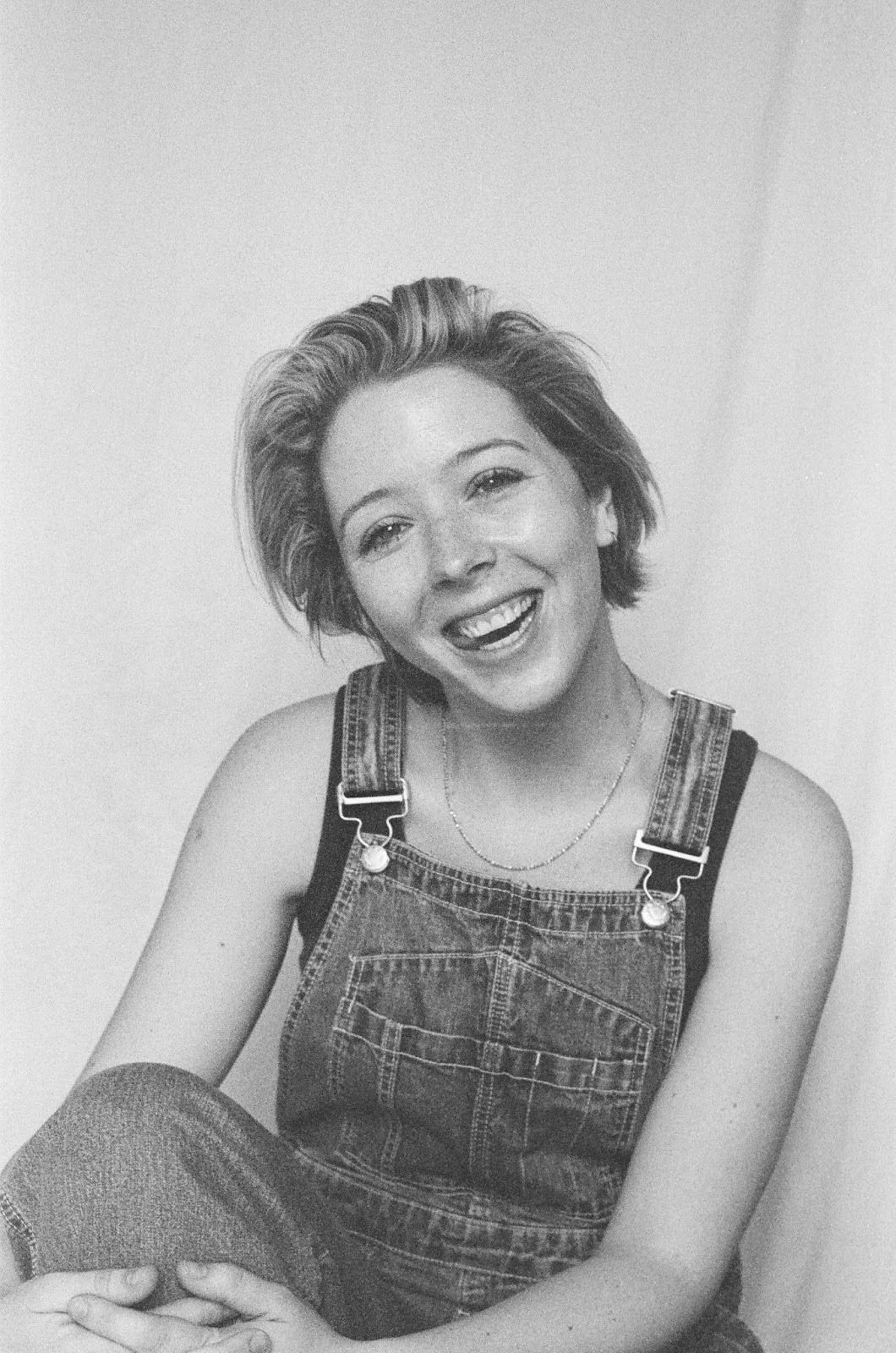
What do you consider to be your hometown?
Generations and generations from both sides of my family were born and still live in North Creek, NY—a tiny town in the Adirondacks. So that’s where I consider home. I’m a literal girl from the North Country!
I also spent a lot of my childhood between Rockland County, NY and Bergen County, NJ—and my mom and my older sister have lived in Seattle, WA and Portland, OR for over a decade—so, those places feel important to me, too!
Where are you currently based?
Like all homosexual playwrights, I’m based in Brooklyn, NY.
What idea or project are you fixated on right now?
I have work sessions for two of my plays coming up this spring. Tremolo is this kind of epic, four act, three and a half hour adaptation of The Seagull about an multi generational lesbian friend group on the dock of a dark lake—and burn for You is about two estranged sisters, and a church attempting to resurrect a child. I’m having lots of discussions about casting and potential homes and long range plans with my teams. It’s really exciting, and most of it feels very out of my control!
Beyond that—I’m a fellow in Juilliard’s Lila Acheson Wallace American Playwrights Program, where our only directive is to write six plays in two years. I’ve written two so far, and my next deadline is May 4. There’s a play I’ve been wanting to write for a long time about a QAnon follower and her estranged son, inspired by my own family. I have been very afraid to write it, but…NO TIME LIKE THE PRESENT.
I’m also beginning to develop some TV projects with collaborators, and there’s one in particular I’m stoked about. I know virtually nothing about this medium, so I’m really out of my depth. Not a bad thing!
What are your other current obsessions (that aren’t necessarily related to your work)?
Sarah Pidgeon’s excellent-a-star-is-born performance as Carolyn Bessette on Love Story, longtime fans of Sarah Pidgeon rise up!
Yelling at people who haven’t seen Sentimental Value yet
Mitski’s new single, I’ll Change For You.
Socks from Imogene and Willie. I got a bunch on sale this November, and they are so warm and thick and cozy.
Pirate’s Booty Cheddar Blast, which comes with 50% more cheese and is a perfect snack.
Any literary drama condensed into a long article from The New York Times or The New Yorker or The Atlantic is my jam. I was really into the Olivia Nuzzi affair this fall, and Who is The Bad Art Friend remains one of my all time favorite things to talk about.
My four beautiful nephews. Winslow is 12, Wyeth and Brooken are 8 year old twins, and Blaise is 4. They are the very, very funny loves of my life. Brooken recently told me I have to write a play about someone named Brooken that is also called Brooken, so…I’m working on that.
Please share a formative influence that shaped you as an artist.
When I was 12 years old, I saw The Light in the Piazza three times on Broadway at Lincoln Center. I don’t know that I truly understood the story, but I remember being so taken with it—it is just so sweeping and glorious and complicated and painfully sad. I didn’t realize that theater could make you feel something before I saw that show.
Around the same time, I auditioned for this Off-Broadway show The American Girls Revue, which used to run at the theater inside the giant American Girl Store near Rockefeller Center. The first time I auditioned, I got a callback. The second time, I got all the way to the end—and my little sister got in. I spent 9 months working on the things they told me to improve upon—I mean, hours and hours of classes and learning the material and busting my ass. And I ended up getting in and doing it for two years. And I suppose that was a formative influence insofar as work ethic—it taught me how tenacious and relentless you have to be.
What themes, images, or other echoes do you find recur in your work?
More than anything, my plays are about the intersection of belief and relationship; those moments when our convictions and ideologies come into direct conflict with the people we love. A friend of mine said my work is about how people will fight their way towards each other even in the face of irreconcilable truths, and I think that’s true. We’re at this fascinating time in our country where we’re watching ideas explode and ricochet against each other–it’s scary to watch, but exciting to write about.
So, because of the above–I write a lot about forms of extremism (political, religious, idealogical, etc), familial estrangement, queerness, sexuality, and shame. There’s usually at least one theatrical or supernatural gesture, because I’m really drawn towards plays that have to live onstage. Most of my work takes place in and around upstate New York because…I know the area, and there’s a cool hauntedness to its nature, too.
Also, humor. Humor, humor, humor. If people are laughing, they’re listening.
Please indulge me in talking a little bit about your process, whatever that means to you. (Feel free to be as brief or as expansive as you like.)
When I first come up with a play, I take down a bunch of initial notes and then put it away. Sometimes there’s no there, there, and I want to see if the characters/relationships/story actually stick with me. I have this master note on my phone with a huge list of potential play ideas. I really think you need to be kind of haunted by a story in order to write it. I also want to make sure I’m writing stuff that challenges me—that forces me to go deeper, or think in a different way, or push myself structurally. So I take some time to assess that.
If I decide to move forward with a play (by which I mean–a deadline is coming up and my hand is about to be forced and I am about to disappoint everyone I have ever known and loved), I begin to consume as much as I can about the world of the play. For burn for You, I worshipped with the church that inspired the story; for my play Nazi Mind, about young boys working on an ill-fated school project, I listened to so many hours of podcasts hosted by boys. I start a crazy Google Doc where I compile all my notes. I take lots of walks. I make these elaborate Spotify playlists with music that feels like the play.
I know it’s time to start writing the play when I begin to write down bits of dialogue—when I can hear the characters talking to me. Then I beat out the story on notecards, which I tape to this one wall over the dining room table that doubles as my desk—and I make a bunch of food and buy provisions so I barely have to leave the house–and I write that motherfucker. My great grandfather Butler apparently used to say, “Don’t start worrying until five minutes after you absolutely have to,” and I think I’ve taken that adage a little too close to heart.
I wish that I was less of a procrastinator, that I woke up at 5:00am every morning and meditated and wrote religiously…but I’m not. I spend months thinking about and building a play, and then I write it in these Diet Coke-fueled all-night benders over the course of 2-3 weeks. That said, one of my teachers at Juilliard recently told me to just embrace that my process is my process, so. Go figure.
You have a background as an actor as well as a writer. How has one craft informed the other, and vice versa?
So many actors become playwrights (or should!) We spend so much time in actor training studying text and character and structure–it’s a very natural transition.
Starting my career as an actor has made me care a lot about writing great roles for actors, and creating complex, thorny, beautiful relationships. One of my acting teachers used to tell me, “The character is in the contradiction”, and that’s something I think a lot about as I build out an ensemble. People can’t just be one thing, and they have to have flaws and shortcomings and moral failures in addition to their strengths and attributes and beauty.
Something I’ve struggled with as a writer because of my acting background is discerning which notes to synthesize, and which to leave on the back burner. As an actor, one of the skills you work to cultivate is how well you take direction–not just, look at how I take this note but, look at how well I take this note. As a writer, you sometimes receive really smart dramaturgical notes, and you sometimes receive inane comments. I’m really working to develop the muscle to pick and choose.
What do you look for in your collaborators?
Warmth, kindness, curiosity, communication, and rigor. I don’t need collaborators to pat me on the ass and tell me how pretty the play is; but I do need people who want to dive deep, and truly make something together. Otherwise, I’d be a novelist, you know?
What changes would you like to see in the industry?
I say this with enormous respect for the challenges of making and producing theater these days—and with the disclaimer that I’ve loved so many of these plays, but…I’m truly over the deluge of one person shows starring celebrities. I would rather see one fully produced, expansive, epic work staged by a company or a team every six months than a slate of one person shows. That’s just me!
Also: plays can be longer than 90 minutes, no intermission–plays can be longer than 90 minutes, no intermission–plays can be longer than 90 minutes, no intermission. Give us something to chew on! Write the story all the way through! Resist the attention economy!
Plugs, please!
My dear friend Sammy Zeisel directed Gooey’s Toxic Aquatic Adventure, which is running through February 28 at The Bushwick Starr.
My pal Susannah Perkins is starring as Antigone in Antigone–This Play I Read in High School at the Public–can you imagine??
I am so excited to see my friend Shayok Misha Chowdhury’s Rhealogy at Playwrights Horizon this spring.
My wonderful pal Rachel Chavkin is directing The Bengson’s My Joy is Heavy at New York Theatre Workshop.
And if you’re somehow reading this from Los Angeles (what’s good?)—the amazing Beth Hyland has her play Sylvia Sylvia Sylvia at The Geffen right now :)
Also gotta plug the work of my fellow Juilliard playwrights who are graduating this spring–Justice Hehir, JuCoby Johnson, Ethan Luk, and Salwa Meghjee. You should read and produce their plays!